Spray Polyurethane Foam Roofing on BC Commercial Buildings: When It Makes Sense
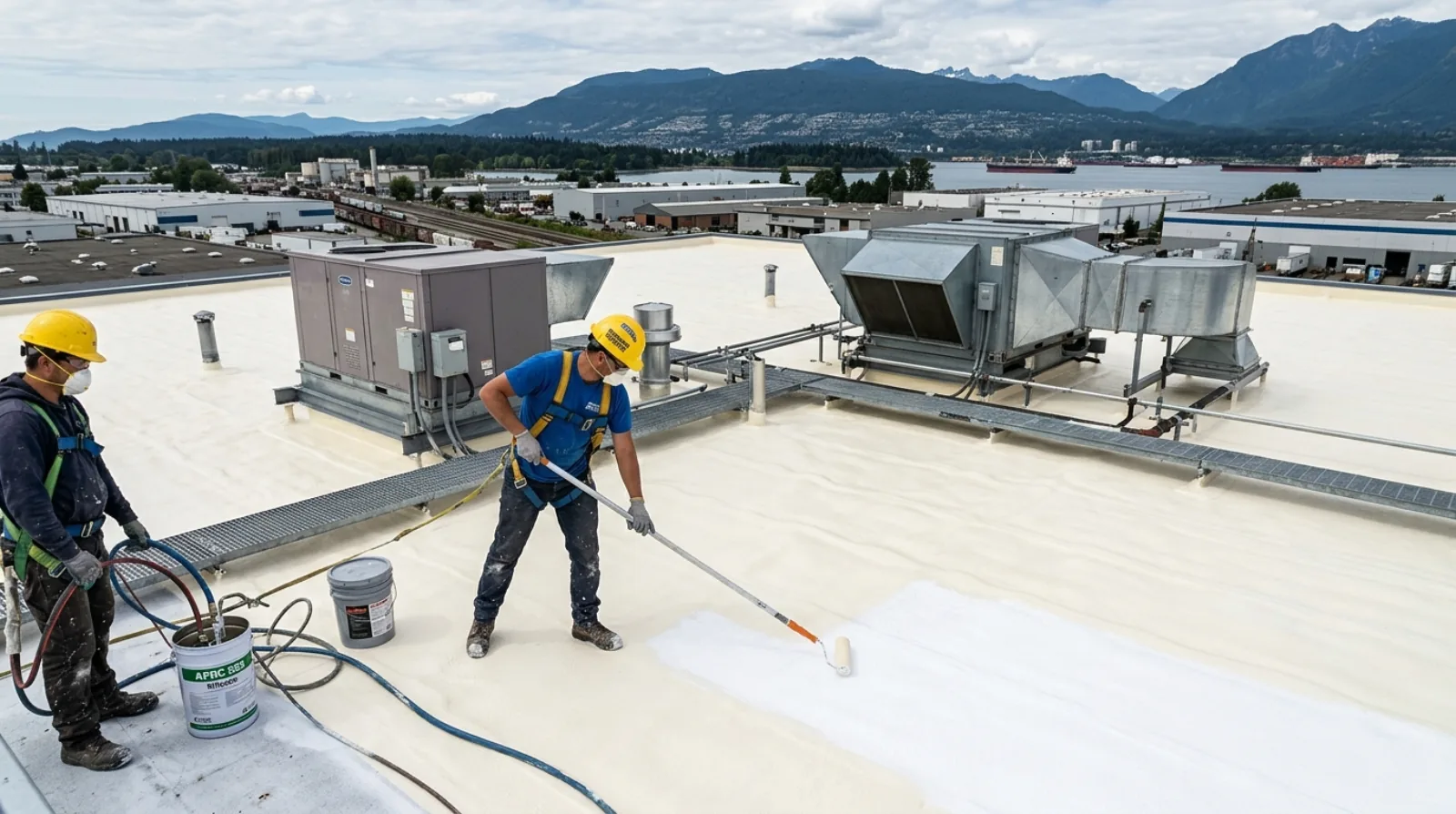
Spray polyurethane foam (SPF) roofing is one of the oldest commercial roofing technologies still in active use. It’s mainstream in the US Southwest, common across the Midwest, and well-established in colder Canadian provinces with continental climates. In coastal BC, it remains a niche choice — used selectively on commercial buildings where its specific advantages align with the project, but rarely the default option on a Lower Mainland flat roof.
This article explains where SPF fits in BC commercial roofing, what to look for in a qualified installation, and how to plan long-term maintenance.
How SPF roofing works
SPF roofing is built up in two phases. First, a two-component polyurethane foam is spray-applied to a clean, dry roof deck. The foam expands roughly 30 times its liquid volume in seconds and cures into a closed-cell rigid insulation that is also waterproof. Standard installation thickness is 1.5–3 inches, providing R-9 to R-21 thermal resistance.
Second, a UV-protective topcoat is applied over the cured foam. The topcoat is critical because raw polyurethane degrades rapidly in sunlight — within months, exposed foam becomes brittle, chalky, and starts to crumble. Topcoats are typically:
- Silicone coating — the dominant choice for commercial SPF in wet climates because of its strong rain resistance and UV stability
- Acrylic coating — lower cost, less rain resistant, suitable for drier climates
- Polyurethane coating — high abrasion resistance, used where foot traffic is significant
The topcoat carries the long-term performance of the system. When it wears out, the foam below is exposed and the clock starts on foam degradation.
SPF’s structural advantages
The technical case for SPF rests on three features that are hard to match with other roofing systems:
One material does two jobs
SPF provides both waterproofing and insulation in a single installation. On a roof recover project where additional insulation is needed, this eliminates the cost of separate rigid insulation, fastening, and seam work. The R-value per inch is excellent — closed-cell polyurethane delivers R-6 to R-7 per inch installed, well above batt or rigid mineral wool insulation.
Zero seams
Every membrane roofing system relies on seams that must be welded, sealed, or lapped. Every seam is a future failure point. SPF is monolithic from edge to edge — there are no seams to fail, no laps to lift, no welds to undercook. On roofs with complex geometry or many penetrations, this is a meaningful long-term advantage.
Self-flashing details
SPF wraps around penetrations, parapet bases, drain bowls, and curbs as it’s sprayed. The foam fills voids and conforms to substrate irregularities that would require careful detail flashing on a membrane system. Done right, the resulting envelope is more forgiving of installation imperfections.
Why SPF is uncommon in coastal BC
If SPF is so capable, why isn’t it the default? Several practical reasons keep it as a niche choice in Metro Vancouver:
Installation weather requirements are narrow
SPF cannot be applied in rain, in high humidity, in wind that would carry overspray onto adjacent property, or in temperatures outside the manufacturer’s spec (typically minimum 5–10°C ambient and rising substrate). In Metro Vancouver, this realistically limits SPF installation to mid-May through September dry windows. A late-fall roof emergency cannot be solved with SPF.
The available installer pool is small
SPF requires significantly more training and specialized equipment than membrane installation. The installer must control mix ratios, spray temperatures, pass thickness, surface profile, and topcoat application. Mistakes appear as voids, lumps, thin spots, and missed flashings — and they fail quickly. The number of contractors in Metro Vancouver with verifiable, long-track-record SPF experience is in the single digits.
Established alternatives have decades of local data
Modified bitumen, TPO, PVC, EPDM, and liquid-applied membrane systems have all been installed across coastal BC long enough that contractors, engineers, and building owners have direct experience with how they perform. SPF doesn’t have the same accumulated track record locally, which makes specifying it a more cautious decision.
Foot traffic and maintenance damage
SPF is more easily damaged by foot traffic than ballasted or membrane roofs. HVAC technicians, telecom installers, and window-cleaning crews walking on an SPF roof can puncture or scuff the topcoat without realizing it. Without immediate touch-up, those scuffs become UV-exposure points for the foam below.
Topcoat maintenance discipline
SPF longevity depends entirely on the topcoat staying intact. If a property owner won’t commit to inspecting the topcoat annually and renewing it every 10–15 years, SPF will underperform. Membrane roofs are more forgiving of deferred maintenance.
Where SPF makes sense in BC
Despite the practical headwinds, SPF is the right answer for some BC commercial buildings:
Roof recovers needing significant insulation upgrade
If a 1980s or 1990s flat roof has minimal insulation and the owner wants to improve energy performance during a recover, SPF can add R-13 or more in a single pass over the existing roof. Adding equivalent insulation under a new membrane system requires tearing off the existing roof, installing rigid insulation, then installing the membrane — a much larger and more expensive scope.
Roofs with complex geometry or many penetrations
A roof with mechanical curbs, exhaust stacks, plumbing vents, satellite mounts, and parapet-to-parapet transitions every few metres is hard to detail with membrane systems. Each penetration is a flashing detail and a future seam-failure point. SPF eliminates all of those seams.
Restoration of structurally sound roofs that are leaking at seams
A roof with intact insulation and decking but failing membrane seams is a strong SPF candidate. Spraying directly over the existing membrane (after cleaning and patching obvious defects) creates a new seamless surface without the cost of teardown.
Tank tops, planter areas, and irregular surfaces
SPF’s ability to conform to any substrate geometry makes it useful for unusual roof areas where membrane installation is awkward or expensive.
The maintenance regime that determines outcome
For SPF to deliver 25–30 year service life in BC, the maintenance regime must include:
- Annual visual inspection for topcoat condition, traffic damage, ponding, and edge deterioration
- Prompt repair of any topcoat damage — voids in the topcoat are urgent items, not deferred maintenance
- Periodic topcoat renewal at the manufacturer’s recommended interval (typically 10–15 years for silicone topcoats)
- Foot-traffic management — walkway pads installed at HVAC equipment, telecom installations, and any routine access path
- Drain and scupper maintenance to prevent ponding that accelerates topcoat wear
For property managers comfortable with this regime, SPF delivers. For owners who treat roofs as install-and-forget assets, it doesn’t.
Comparing total cost of ownership
Direct material comparison favors membrane systems. Installed cost per square foot for SPF in BC is typically comparable to or slightly higher than mid-tier TPO or PVC membrane, particularly accounting for the topcoat renewal cycle every 10–15 years.
However, when SPF is being compared on a roof recover application where the alternative requires substantial insulation upgrade and full teardown, the SPF total cost is often significantly lower. When the alternative is a complex membrane installation with many flashings, SPF’s elimination of seam detailing can also close the cost gap.
A meaningful cost comparison requires scoping both systems for the specific building, accounting for:
- Tear-off and disposal cost (often eliminated with SPF recovers)
- Insulation material and labour cost
- Membrane vs. SPF and topcoat material and labour cost
- Detail and flashing labour
- Long-term maintenance cost and recoat cycles
- Insurance and warranty differences
For most BC commercial buildings, the analysis comes out in favour of a membrane system. For specific buildings — particularly those with complex geometry and insulation upgrade needs — SPF wins on whole-life cost.
Decision checklist for a BC commercial roof project
If you’re considering SPF for a Lower Mainland commercial roofing project, work through these questions:
- Does the project benefit from insulation upgrade? If yes, SPF gets stronger consideration.
- Is the roof geometry complex? Many penetrations and curbs favour SPF.
- Is the existing roof structurally sound? SPF recovers depend on a stable substrate.
- Is the installation window in May–September? Outside this window, SPF is impractical in BC.
- Can you engage a qualified BC SPF installer? This is often the gating question.
- Will the owner commit to topcoat maintenance? Without this, SPF will underperform.
- Has roofing engineering reviewed the assembly? Code compliance and long-term performance both depend on a properly engineered system specification.
If you can answer yes to most of these, SPF is worth pricing alongside membrane alternatives. If most answers are no, stick with a membrane system that fits BC’s installer base and weather realities.
Related guides
- Building Envelope Condition Assessment — establishing roof condition before choosing a replacement system
- Atmospheric Rivers and Building Envelope Performance — what BC’s wet season demands of roof systems
- Coordinating Strata Exterior Restoration — how roof scope fits within a larger envelope project
- Fall Maintenance Checklist for Strata — annual roof inspection items